




Floating Deck Blocks Australia: A Guide to No-Dig Deck Foundations

Quick Answer for Builders and DIYers:
Floating deck blocks are preformed foundation supports that sit on a stable, compacted base and support the frame of a freestanding deck. Instead of digging holes, pouring concrete or waiting for footings to cure, you prepare each support point, place the blocks, level them, and start framing.
In Australia, floating deck blocks are especially useful for low-profile decks, sloping yards, tight access areas, garden sheds, pool surrounds and outdoor projects where concrete is slow, heavy or unnecessary. TuffBlock is made from structural-grade recycled polyolefin, supports up to 770 kg per block, is break-tested to 4,990 kg, and is backed by a 25-year warranty.
JUMP TO WHAT YOU NEED
In this guide:
- What are floating deck blocks?
- How do floating deck blocks work?
- Floating deck blocks vs concrete footings
- Floating deck blocks vs concrete deck blocks
- What to look for when buying floating deck blocks
- What can you build with floating deck blocks?
- How to build a floating deck with deck blocks: 3 steps
- How many floating deck blocks do you need?
- Floating deck blocks on different surfaces
- Floating deck blocks in the Australian climate
- Do you need council approval for a floating deck?
- FAQ
What Are Floating Deck Blocks?
Floating deck blocks, also called deck foundation blocks, deck pier blocks, or deck footing blocks, are preformed structural supports used to build the foundation of a floating deck without any digging or concrete work.
They sit directly on the ground and carry the timber frame above them. Each block has moulded saddles designed to accept standard timber sizes, posts, joists, and bearers drop straight in, no cutting or fitting required.
The term “floating” refers to the fact that the deck is not anchored into the ground with traditional in-ground footings. Instead, the structure sits on surface-level supports and can accommodate minor natural ground movement over time. Floating foundation systems have been used for decades on decks, sheds and other outdoor structures, providing a practical alternative to concrete footings in suitable applications. When correctly designed and installed on a stable, compacted base, they can help reduce excavation, minimise site disturbance and make construction faster and more accessible for builders and DIYers alike.
TuffBlock is the leading floating deck block in Australia, load-rated to 770kg per block, break-tested to 4,990kg, made from structural-grade recycled polyolefin, and backed by a 25-year warranty.
How Do Floating Deck Blocks Work?
The concept is simple. Instead of digging holes and pouring concrete footings, you prepare a level, compacted base at each support point and place a deck block on top. Your timber frame, joists, bearers, or posts, sits in the block's moulded saddle, and the weight of the deck is distributed down through the block into the ground.
Because the blocks sit on the surface rather than being fixed below it, the structure can shift very slightly as the ground naturally expands, contracts, or settles. This movement is managed, not resisted, which reduces stress on the structure over time and prevents the cracking and heaving that rigid concrete footings can suffer in reactive or poorly drained soils.
The three-step process:
- Prepare the base — clear vegetation, compact the soil, and add a layer of gravel at each block location for drainage and stability
- Place and level the blocks — position each TuffBlock, check level in both directions, adjust the gravel base as needed.
- Build your frame — drop your joists, bearers, or posts into the block saddles and start framing immediately.
No curing time. No specialist equipment. No concrete.
Floating Deck Blocks vs Concrete Footings and Concrete Deck Blocks
This is the comparison most DIYers are making when they start researching floating deck blocks. Here's how the two methods stack up on a standard 3.6m × 3.6m floating deck:
| FEATURE & BENEFITS | Floating Deck Blocks (TuffBlock) | In-Ground Concrete Footings |
|---|---|---|
| Digging required | ✘ | ✔ (to engineered depth) |
| Concrete required | ✘ | ✔ |
| Total material weight handled | ~12kg | ~365-910kg |
| Foundation install time | 45–70 minutes (avg) | 24+ hours |
| Ready to frame | Immediately | After curing (days) |
| Risk of hitting utilities | ✘ | ✔ |
| Ground movement | Floats with it | Rigid – can crack or shift |
| Lowest build height | 165mm above ground level | Typically 300-450mm minimum |
| Cost per support point | ~ $12.00 | ~ $24-30.00+ |
| Permit required | ✘ (check your local council) | ✔ |
| Relocatable | ✔ | ✘ |
| Warranty | 25 years (TuffBlock) | ✘ |
For ground-level floating decks, the case for deck blocks over concrete footings is clear on almost every metric. The only scenarios where in-ground concrete footings are the better, or required, choice are elevated decks, decks attached to the home, or where your council specifically mandates them.
There's a second comparison worth making, between plastic floating deck blocks like TuffBlock and the traditional grey concrete deck blocks you'll find at hardware stores. They look similar but perform very differently.
| FEATURE & BENEFITS | Floating Deck Blocks (TuffBlock) | Concrete Deck Blocks |
|---|---|---|
| Weight per block | ~680g | ~4,680g |
| Lowest build height | 165mm | 300-450mm |
| Absorbs moisture | ✘ | ✔ |
| Cracks over time | ✘ | ✔ |
| UV-resistant | ✔ | ✘ |
| Warranty | 25 years | ✘ |
| Adjustable on slope | ✔ (with post extensions) | Limited |
| ICC-ES certified | ✔ | ✘ |
| Load rating (verified) | ~770kg | Unverified |
Concrete deck blocks are heavy, absorb moisture, and offer no warranty. TuffBlock is 27× lighter, won't crack or corrode, and comes with a 25-year guarantee.
What to Look for When Buying Floating Deck Blocks
Not all floating deck blocks are equal, and given the number of unverified imports on the market, it's worth knowing exactly what to check before you buy.
Verified load rating. Any structural product used as a foundation should have a published, independently verified load rating. TuffBlock is rated to 770kg per block with a break test to 4,990kg, and carries full testing documentation you can hand to your council building department if it's needed for an approval. Avoid any block that lists a claimed capacity without certification data to back it up.
Material quality. Structural-grade polymer with UV stabilisation is what you need for outdoor use in Australia. Cheap imports use unknown plastic compositions with no UV protection — they degrade, warp, and become brittle within a few seasons. TuffBlock is made from high-strength closed-loop recycled polyolefin with UV stabilisers built into the manufacturing process.
Low-profile capability. If you want a ground-level floating deck, your blocks need to support a build as low as 150mm above ground level. Many concrete blocks physically can't go that low.
Timber compatibility. Fits standard AU timber sizes (90×90mm or 100×100mm posts, 35–47mm joists and bearers) straight out of the box, no cutting or packing needed.
Warranty. A 25-year warranty signals genuine confidence in the product's durability. No concrete deck block comes with a warranty. Most unverified plastic imports don't either.
What Can You Build Using Floating Deck Blocks?
Floating deck blocks aren't just for decks. Because they're versatile, load-rated, and work on almost any stable surface, TuffBlock is used across a wide range of outdoor builds:
Floating decks — ground-level, low-profile, and freestanding floating platform decks of any size. The most common application — and one of the most budget-friendly ways to add usable outdoor space. Need inspiration? See 6 floating deck ideas using deck blocks.
Garden sheds and workshops — a shed base built on TuffBlocks is faster, cheaper, and more adjustable than a concrete slab. It also keeps timber off the soil, reducing rot and termite risk.
Raised walkways and garden paths — connecting structures, spanning uneven terrain, or creating accessible pathways through a garden.
Stairs and landings — TuffBlocks support stair stringers and landing frames cleanly without the need for concrete piers at each contact point.
Hot tub platforms — with each block rated to 770kg, a TuffBlock platform easily handles the combined weight of a spa, water, and occupants when blocks are correctly spaced.
Cubby houses and playhouses — a safe, stable foundation that's quick to build and doesn't require excavation near play areas.
Pool surrounds and outdoor shower platforms — TuffBlock doesn't absorb moisture, making it ideal for wet environments where concrete blocks would degrade.
Greenhouse bases — as one TuffBlock customer noted:
"TuffBlocks made building the foundation of our greenhouse so much simpler than any other method would have been, especially on a slope next to the house, where no digging was possible."


How to Install Floating Deck Blocks: 3 Steps
Prepare Your Base
Mark out your deck footprint and identify each block location based on your joist and bearer layout. At each location:
- Clear away any grass or vegetation
- Compact the soil firmly with a hand tamper
- Add a layer of compacted gravel (road base or crusher dust) — typically 2"–4" deep
- Level the gravel at each point
The gravel layer improves drainage under the block and gives you a fine-tunable surface for getting each block perfectly level.
Place and Level Your Blocks
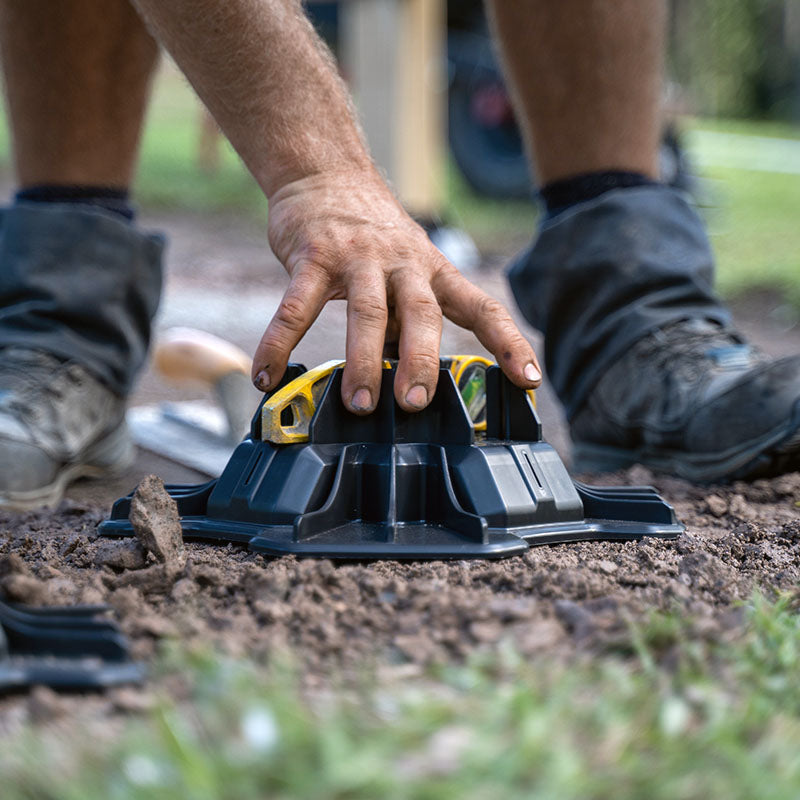
Set each TuffBlock on the prepared gravel base. Check level in both directions using a spirit level. Add or remove gravel beneath the block to adjust.
On sloping ground, use 4×4 extension posts sitting in the block saddle to bring the frame to level — the greater the slope, the taller the post at the lower end.
For large decks, set corner blocks first and run string lines between them as a reference for intermediate block heights. A laser level significantly speeds this step up on decks over 12ft in any direction.
Build Your Frame
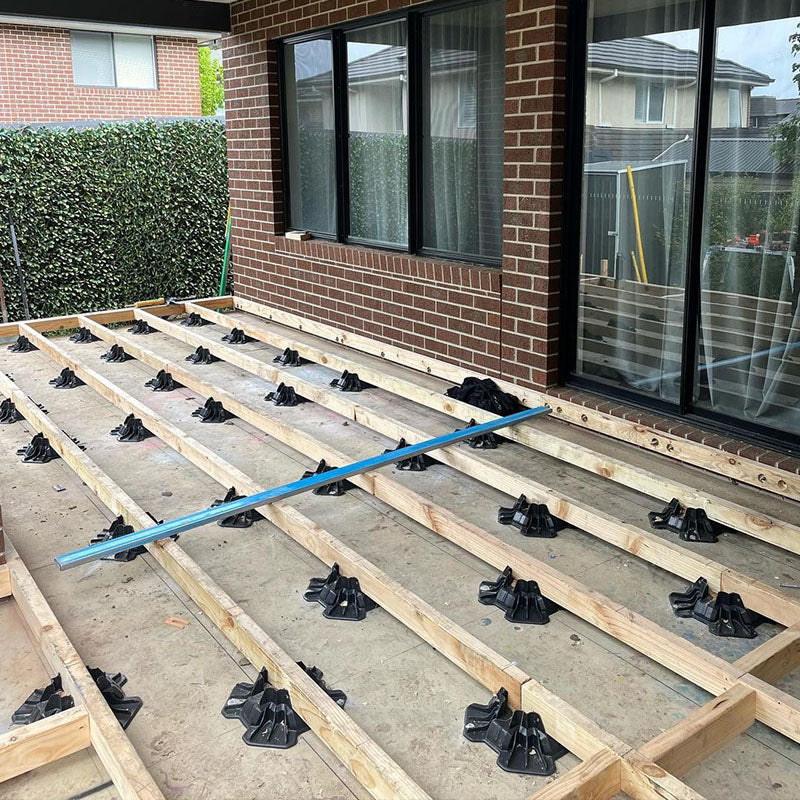
Once all blocks are placed and level, drop your joists, bearers, or posts into the TuffBlock saddles and begin framing. No waiting. No curing. No second visit.
TuffBlock accepts:
- Posts: 3.5"×3.5" or 4"×4"
- Joists and bearers: 1½"–2" width
Generally no fixing is required — the weight of the structure holds everything in position. In high-wind areas, earth anchors can be used to secure the overall structure.
How to Install Floating Deck Blocks: 3 Steps

Step 1: Prepare Your Base
Mark out your deck footprint and identify each block location based on your joist and bearer layout. At each location:
- Clear away any grass or vegetation
- Compact the soil firmly with a hand tamper
- Add a layer of compacted gravel (road base, crusher dust, or decomposed granite works well), typically 50–100mm deep
- Level the gravel at each point
The gravel layer does two jobs: it improves drainage under the block (preventing moisture build-up) and gives you a fine-tunable surface for getting each block perfectly level. For the full ground prep walkthrough, see Deck block prep 101.

Step 2: Place and Level Your Blocks
Set each TuffBlock on the prepared gravel base. Check level in both directions using a spirit level. Add or remove gravel beneath the block to adjust. On sloping ground, use 90×90mm extension posts sitting in the block saddle to bring the frame to level, the greater the slope, the taller the post at the lower end.
For large decks, set corner blocks first and run string lines between them as a reference for intermediate block heights. A laser level speeds this step up significantly on decks over 3.6m in any direction.

Step 3: Build Your Frame
Once all blocks are placed and level, drop your joists, bearers, or posts into the TuffBlock saddles and begin framing. No waiting. No curing. No second visit.
Generally no fixing is required between the timber and the block — the weight of the structure holds everything in position. In high-wind areas, earth anchors can be used to secure the overall structure.
From here, follow our 10-step deck build guide for framing, decking boards, and finishing.
- Part 1
- Part 2
How Many Floating Deck Blocks Do You Need?
The number of blocks you need depends on your deck size, timber dimensions, joist spacing, and whether you're using a bearer system. The same 3m × 6m deck can require anywhere from 12 to 54 TuffBlocks depending on configuration.
Quick estimates for common deck sizes (400mm on-centre joist spacing):
| Deck Size | Estimated TuffBlocks |
|---|---|
| 2m × 3m | 15 |
| 3m × 3m | 21 |
| 3m x 4m | 28 |
| 4m x 5m | 36 |
| 6m × 8m | 78 |
| 6m × 9m | 91 |
For your exact number, use our TuffBlock Deck Calculator.
Or read our full spacing guide: How Many Deck Blocks Do You Need?
Floating Deck Blocks on Different Surfaces
One of the practical advantages of TuffBlock is that it works on almost any stable surface, not just bare soil.
Compacted soil or subsoil — the most common application. Prepare with compacted gravel at each block location.
Existing concrete slab or patio — TuffBlocks sit directly on concrete with no preparation needed. Building a floating deck over a concrete slab is one of the most popular TuffBlock projects: no drilling, no anchoring, no damage to the slab.
Gravel — works well. The block's base footprint distributes load across the gravel without sinking on a properly compacted base.
Pavers — TuffBlocks can sit on pavers provided the paver base is stable and level. Good for deck extensions over existing paved areas.
Grass and turf — clear the vegetation and compact the soil beneath before placing blocks. Do not place directly on uncompacted turf, the block will shift as the turf compresses over time.
What doesn't work: permanently waterlogged or flooded ground, very soft reactive clay without drainage improvement, or surfaces that are not structurally stable. If in doubt, add more blocks to spread the load, or improve drainage before building.
Floating Deck Blocks in Australian Conditions
Australian conditions can be punishing, here's what matters locally — and how a floating block foundation handles it.
- UV and heat — Australian UV levels are among the highest in the world. Unstabilised plastics chalk, fade, and turn brittle within a few seasons. TuffBlock's polyolefin is UV-stabilised during manufacturing and carries a 25-year warranty for outdoor exposure.
- Reactive clay soils — Large parts of Australia sit on clay that swells when wet and shrinks when dry. Rigid in-ground footings fight that movement and can crack or heave. A floating foundation moves with the ground instead, the same reason floating slab construction is used on reactive sites.
- Termites — Concrete blocks hold timber at or near soil level. TuffBlock keeps the frame above the soil line, improving airflow and keeping timber out of direct ground contact, one less pathway for termites and rot.
- Drainage and storm rain — TuffBlock doesn't absorb moisture, and the compacted gravel base under each block keeps water moving away from the support points. Concrete blocks wick moisture up into the timber sitting on them.
- Coastal exposure — No steel, no corrosion. Polymer blocks are unaffected by salt air, making them well suited to coastal builds where galvanised stirrups and fasteners degrade.

If you're building in Australia's small alpine zone, the floating approach still works in seasonal freeze conditions, the blocks ride out minor ground movement rather than resisting it.
Do You Need Council Approval for a Floating Deck?
A floating deck is still considered a deck for approval purposes. While the footing system may be different from a traditional in-ground foundation, this does not automatically make the project exempt from planning or building requirements.
Approval rules vary between states, councils and individual properties. Factors such as the deck’s height, total area, setbacks, roofing, pool fencing, zoning and property overlays can all affect whether approval is required.
Examples of Floating Deck Approval Rules by State
| Location | General Guidance |
|---|---|
| Queensland | A small, unroofed deck may not require building approval if it is no more than 10 m² in area, no higher than 1 m above natural ground level and no longer than 5 m on any side. Planning requirements and site-specific conditions may still apply. |
| New South Wales | A deck may qualify as exempt development if it meets the relevant criteria, including a maximum area of 25 m², a floor height no more than 1 m above existing ground level and a maximum overall height of 3 m. Setbacks and other site-specific conditions also apply. |
| Victoria | A building permit is generally required for a deck regardless of its size. A separate planning permit may also be required depending on the zoning, overlays and characteristics of the property. |
These examples are intended as a general guide only. Before starting construction, check the requirements with your local council, a licensed building certifier or a registered building surveyor.


Your deck could start this weekend.
No digging. No concrete. No waiting for footings to cure. TuffBlock is the floating deck foundation you place, level and build on the same day.
⭐️⭐️⭐️⭐️⭐️ Based on 500+ reviews
Shop NowAlso available at your local Bunnings Warehouse
FAQ
Read more...
Floating Deck Blocks Australia: A Guide to No-Dig Deck Foundations
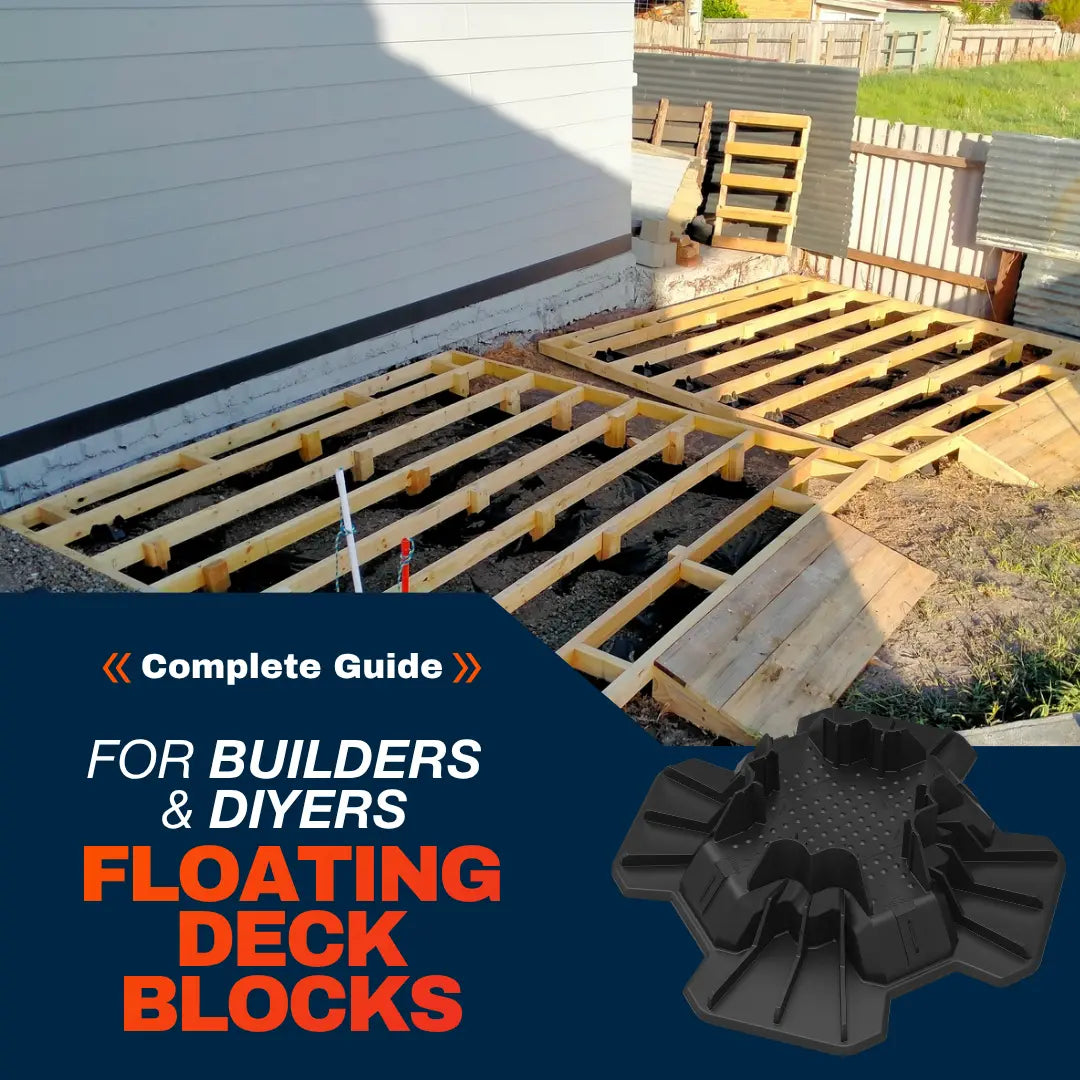
Floating deck blocks - also called deck foundation blocks or deck footing blocks, let you build a floating deck or platform with no digging and no concrete. This guide covers how floating decking works, what to look for when buying blocks, how many you need, and the council rules that apply in Australia.



Ready to Build?
TuffBlock is available online with free shipping across Australia

150K + BUILDS

Build decks as low as 165mm

25 YEAR WARRANTY

MADE IN AUS